
Expanding your business into India opens the door to one of the fastest-growing economies in the world. If you’re based in the United States and planning to set up a business overseas, understanding the process of company registration in India is essential. This guide simplifies every step to help you move forward with clarity and confidence.
Why Register a Company in India?
India offers strong opportunities for foreign investors due to its rapidly growing economy and business-friendly reforms.
- Access to a large and expanding consumer market
- Government initiatives supporting foreign investment
- Cost-effective operations
- Skilled workforce across multiple industries
Types of Business Entities in India
Private Limited Company
- Separate legal identity
- Limited liability protection
- Allows foreign direct investment
Limited Liability Partnership (LLP)
- Flexible structure
- Fewer compliance requirements
- Ideal for professional services
Wholly Owned Subsidiary
- 100% foreign ownership permitted in many sectors
- Best suited for US companies expanding into India
Branch or Liaison Office
- Extension of a foreign company
- Limited operational scope
Step-by-Step Process for Company Registration in India
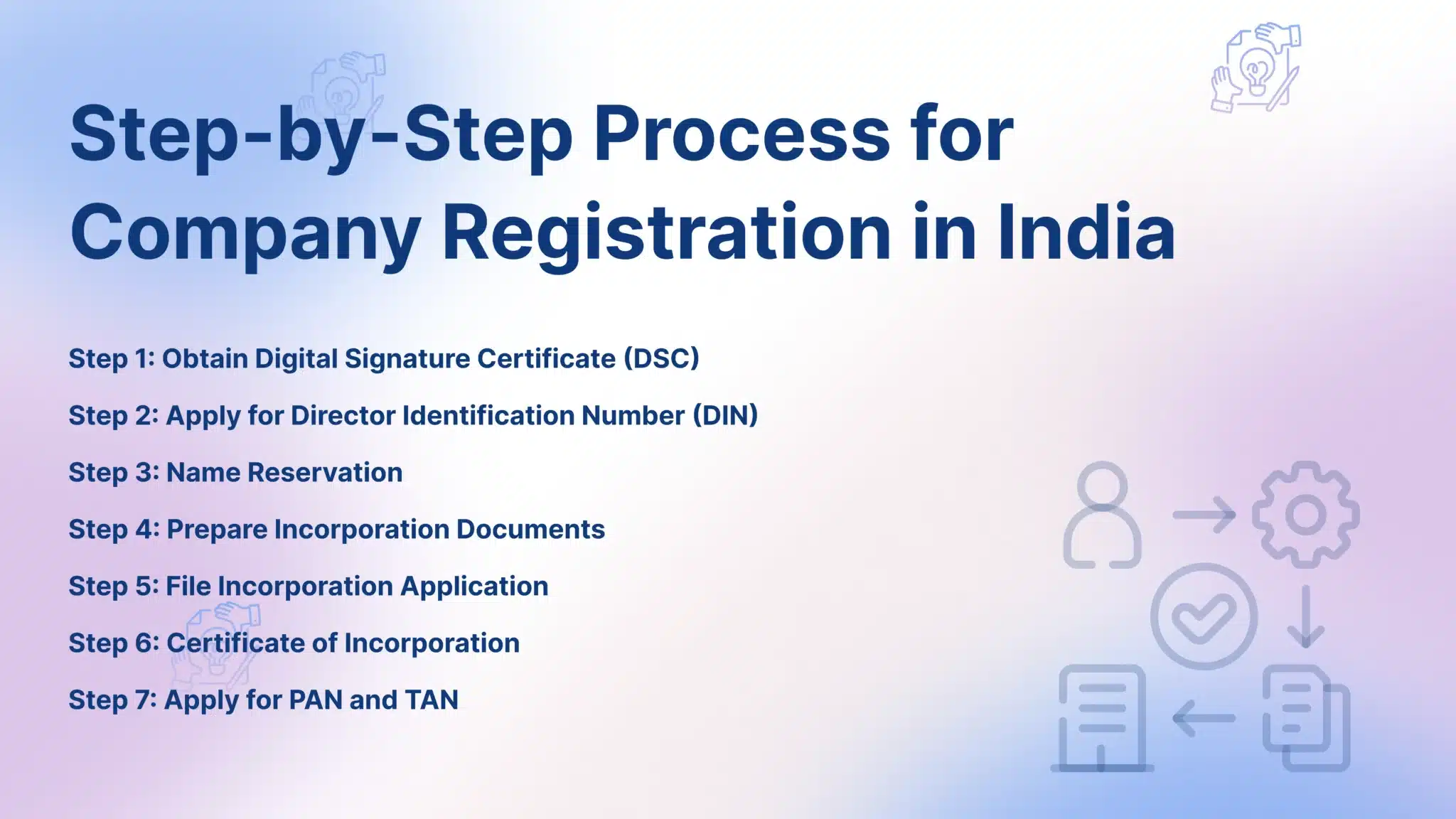
Step 1: Obtain Digital Signature Certificate (DSC)
All directors must obtain a DSC to sign documents electronically.
Step 2: Apply for Director Identification Number (DIN)
Each director must have a unique DIN issued by the Ministry of Corporate Affairs.
Step 3: Name Reservation
Select a unique company name and apply for approval through the MCA portal.
Step 4: Prepare Incorporation Documents
- Memorandum of Association (MoA)
- Articles of Association (AoA)
- Registered office proof
Step 5: File Incorporation Application
Submit the SPICe+ form along with all required documents online.
Step 6: Certificate of Incorporation
Once approved, the Registrar issues a certificate confirming your company’s legal existence.
Step 7: Apply for PAN and TAN
These tax identification numbers are mandatory for business operations in India.
Documents Required for US Residents
- Notarized and apostilled passport
- Address proof (bank statement or utility bill)
- Passport-size photograph
- Registered office address in India
Cost of Company Registration in India
The cost depends on government fees, professional charges, and business requirements.
Timeline for Registration
The process typically takes 7 to 15 working days, depending on document readiness and approvals.
Post-Registration Compliance
- Annual filings with MCA
- Income tax returns
- GST registration (if applicable)
- Maintaining financial records
Benefits for US Entrepreneurs
- Full ownership in many sectors
- Growing startup ecosystem
- Favorable tax structure
- Global expansion opportunities
Common Challenges
- Understanding regulatory requirements
- Managing documentation for foreign nationals
- Navigating compliance rules
Conclusion
Setting up a business in India is a strategic decision for US entrepreneurs looking to expand globally. With the right approach and professional support, the process of company registration in India becomes smooth, efficient, and rewarding at FinGuru India.


