
If you’re planning to launch your business in India, setting up a Private Limited Company is one of the smartest moves you can make. It’s the most trusted and scalable business structure for startups and small businesses alike. At FinGuru India, we’ve helped thousands of entrepreneurs navigate the process of Private Limited Company Registration in India, and in this guide, we’ll walk you through every detail from the required documents to the registration process and expert tips to avoid delays.
By the end, you’ll know exactly what you need to register a Private Limited company, whether you’re an Indian citizen or a foreign national.
Advantages of Registering a Private Limited Company
Before getting started, it’s essential to understand what the process of registering a private limited company involves:
Limited liability for owners
With a private limited company in India, the liability of shareholders is limited to their shareholding. Personal assets are better protected than in sole proprietorships or partnerships.
Separate legal existence
The company becomes a legal entity in its own right. It can hold property, enter into contracts, sue or be sued, independent of its owners. This adds credibility.
Easier to raise capital and growth potential
Investors, lenders and other stakeholders tend to view registered private limited companies more favorably. If you’re planning to scale, the formal structure helps.
Continuity and ownership transfer
Even if shareholders change or directors step down, the private limited company remains in existence. That continuity can matter if you aim for long-term business.
Professional image and compliance advantage
Having “Pvt. Ltd.” in your name signals a formal business structure to clients, suppliers, and partners. Also, compliance with the Companies Act, 2013 and MCA rules adds trust.
Registering a private limited company in India comes with paperwork and formalities, but the long-term benefits often make it worthwhile.
List of Required Documents (for Indian Nationals and Foreign Nationals)
Simple ways to register Pvt. Ltd. Company Registration
Before beginning the registration process, it’s crucial to understand the documents required for a Private Limited Company Registration in India. Proper documentation ensures a smooth and error-free application with the Ministry of Corporate Affairs (MCA). To make it easier, we’ve outlined the complete list of documents you’ll need separately for Indian nationals and for foreign nationals — so you can prepare each set accurately and avoid unnecessary delays.
For Indian Nationals
When you decide to register a private limited company in India and the directors/shareholders are Indian nationals, these are the commonly required documents:
- Identity Proof: PAN card (mandatory for Indian citizens).
- Address Proof: One of the following – Aadhaar card, driver’s licence, voter ID, utility bill, bank statement (recent) in the name of the person. Utility bill or bank statement should not be older than 2 months.
- Passport-sized photographs: For each director and shareholder.
- Proof of Registered Office Address:
- If the company owns the premises: Sale deed/title deed (ownership) + Electricity Bill
- If rented: Rental/lease agreement + No Objection Certificate (NOC) from the landlord + Electricity Bill
- Recent utility bill of the registered office in the name of the company or landlord/owner + Electricity Bill
- Memorandum of Association (MOA) & Articles of Association (AOA): Initial documents that establish the company’s constitution.
- Digital Signature Certificate (DSC) for proposed directors and/or shareholders: Required for online filing.
- Director Identification Number (DIN) for each proposed director (if not already obtained separately).
- Application form for incorporation: The integrated form via the MCA portal, such as SPICe+ (INC-32) (or relevant) along with attachments.
For Foreign Nationals / NRIs
If one or more shareholders or directors are foreign nationals (or NRIs), then in addition to most of the basics above, you’ll need:
- Passport of foreign national (as identity proof).
- Address proof of foreign national (bank statement, utility bill, residence card, etc) with recent date (i.e. not older than within 2 months).
- Apostille / notarised copy of the above documents.
- If the foreign national is a shareholder via a corporate entity: additional documents for that entity (Incorporation Certificate, Board Resolution, Articles of the Company, address proof of entity) is also required.
Process to Register a Private Limited Company
What this really means is: Once you have the documents, here’s how you go about registering the private limited company in India.
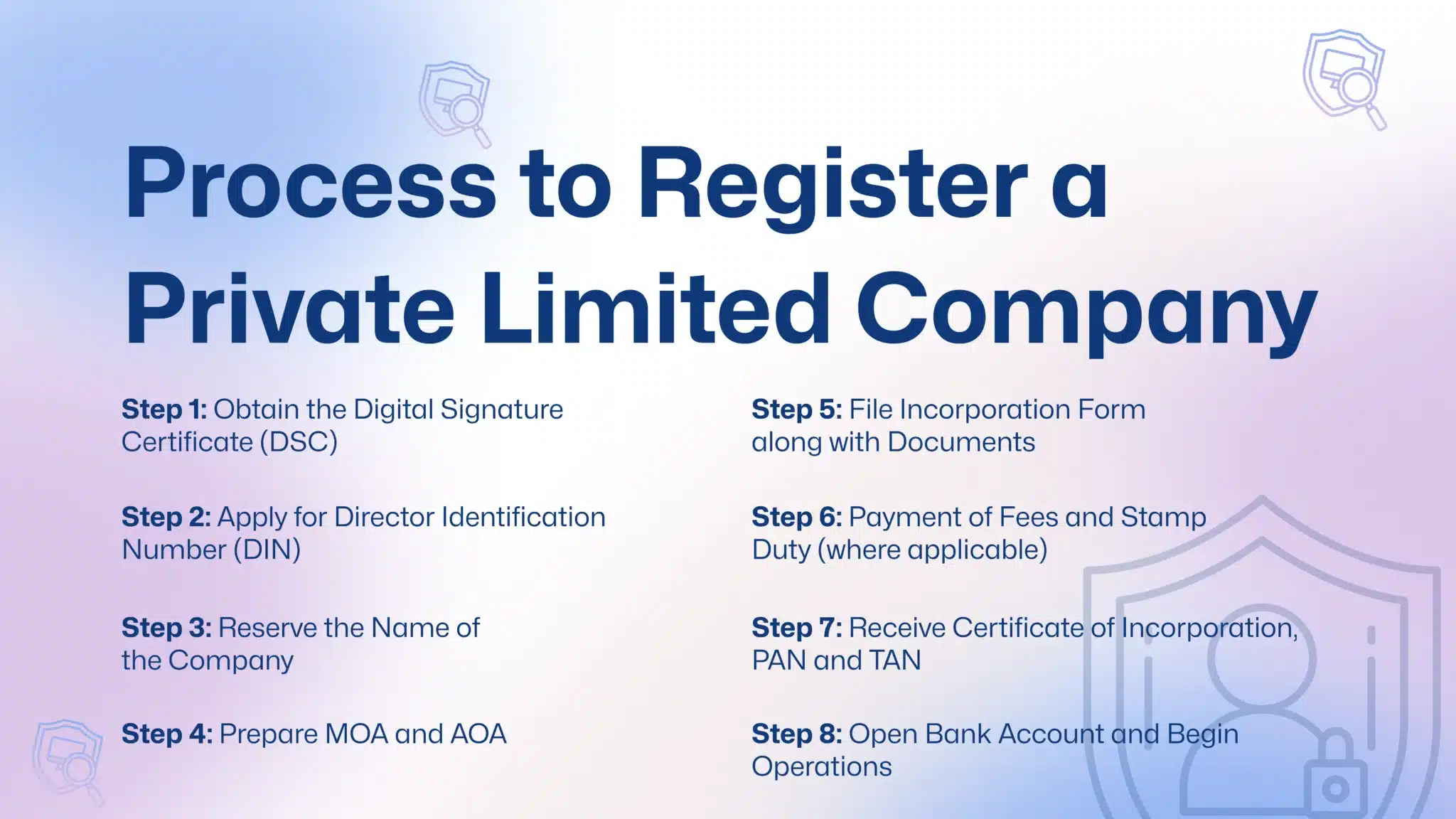
- Obtain the Digital Signature Certificate (DSC)
All proposed directors need a DSC. This is used for electronically signing the incorporation documents on the MCA portal. - Apply for Director Identification Number (DIN)
If any of the proposed directors don’t have a DIN, they can apply via the prescribed mode. For new companies it’s integrated in SPICe+. - Reserve the Name of the Company
Using Spice part A the name can be reserved and it must be unique and comply with naming rules. - Prepare MOA and AOA
Draft the Memorandum of Association and Articles of Association (either as e-MOA/e-AOA or manually depending upon the Company type) and get them signed by subscribers using DSC or manually. These define the scope of business and internal rules. - File Incorporation Form along with Documents
On the MCA portal file the SPICe+ (incorporation) form (or equivalent). Attach identity/address proofs of directors/shareholders, registered office proof, MOA/AOA, DSCs, etc. - Payment of Fees and Stamp Duty (where applicable)
Government fees depend on authorised capital and other factors. Once all is in order, the ROC issues the Certificate of Incorporation (COI). - Receive Certificate of Incorporation, PAN and TAN
After approval you’ll get the COI (which gives your Corporate Identification Number, CIN). The company automatically gets PAN and TAN in many cases. - Open Bank Account and Begin Operations
Submit COI, PAN, AOA, MOA, and KYC documents to open the bank account.
Checks for Pvt. Ltd. Company Registration
Here are practical pointers to things I’ve learned over 7+ years helping businesses register companies to avoid delays and surprise hassles.
- Double-check all identity and address proofs: They must be clear, correct, and updated (utility bills or bank statements not older than 2 months, else it will get rejected).
- Ensure the registered office address is valid and you have proof: If rented, get a proper lease agreement + NOC from landlord. If owned, you have ownership proof. Any mismatch in address or document can raise questions.
- Choose the company name carefully: It should not match or be too similar to existing companies or trademarks. A rejected name delays the process.
- Make sure DSCs and DINs (if applicable) are applied for early: They often take time depending on the service provider and verification steps.
- Keep the MOA and AOA drafting simple but compliant: Complex business objectives or unusual clauses might trigger queries with the ROC.
- Upload clear digital copies: Since most filings are online via MCA portal, blurred scans, unreadable signatures or incomplete uploads cause backlog.
- If you have foreign directors/shareholders: Check for apostille/notarisation requirements. Delays often come from lack of translation/verification of overseas documents.
- Maintain chronology in your submission: Name approval → DSCs/DIN → MOA/AOA drafting → Incorporation filing. Skipping or reordering can cause confusion.
- After incorporation, ensure you fulfil post-registration compliances: Opening bank account, GST registration (if required), filing annual returns, etc. Starting strong helps avoid penalties.
Conclusion
Registering a private limited company in India is a significant step and doing it right means having your documents and process aligned. Whether you’re an Indian national or include foreign nationals in your shareholding/directorship, the document checklist remains manageable if you prepare ahead.
What this really means: if you gather identity proofs, address proofs, office address proof, MOA/AOA, DSCs/DINs, and follow the steps as per the MCA guidelines, you’ll minimise delays and smoothly complete the private limited company registration in India.
With a properly registered private limited company, you’ll enjoy limited liability, independent legal identity, and greater credibility as your business grows. If you’d like a downloadable checklist or help on a specific part (say, foreign shareholder documentation or office address proof), I’d be happy to pull together a tailored version for you.
Get Professional Guidance Today!
Call: +91-9999127022
Visit: www.finguruindia.com