If you’ve ever paid salaries, hired consultants, or made rent payments that required tax deduction, you’ve probably come across the term TAN. It’s one of those short tax acronyms that most people ignore until they realize they can’t file or deposit TDS without it.
Here’s the thing: without a TAN number, any tax you deduct on behalf of the government can’t be tracked, credited, or filed. It’s the code that identifies you as the tax deductor.
As of 2024, India has more than 2.6 crore registered TAN holders, including companies, government offices, and individuals. The system helps the Income Tax Department monitor trillions of rupees in Tax Deducted at Source (TDS) every year.
In simple words, the tan full form Tax Deduction and Collection Account Number represents accountability. It ensures the tax deducted from someone’s income doesn’t just disappear; it reaches the right place, under the right account.
Let’s go step-by-step through what TAN is, why it matters, and how you can apply for one quickly and correctly.
What is TAN?
The TAN full form is Tax Deduction and Collection Account Number. It’s a unique 10-character alphanumeric code issued by the Income Tax Department of India to anyone responsible for deducting or collecting tax at source.
Think of the TAN number as an identity for tax deductors individuals, companies, banks, or government bodies.
Here’s how it works: let’s say a company pays ₹80,000 per month in rent. Under Indian tax rules, it must deduct 10% TDS, i.e., ₹8,000 before paying the landlord. The company can only deposit this TDS with the government if it has a valid TAN.
Without it, the deposit can’t be processed, and both the payer and the payee could face compliance issues.
The tan full form in income tax language literally defines its purpose it’s the government’s record of who is deducting tax and who it’s collected from.
Why TAN Matters
The TAN number is more than just a code it’s a legal requirement. Under Section 203A of the Income Tax Act, 1961, every person or entity that deducts or collects tax must obtain a valid TAN.
According to data from the Income Tax Department, over ₹17 lakh crore worth of tax was collected through TDS and TCS in the 2023–24 fiscal year. Managing and crediting these deductions accurately would be impossible without a standardized tracking system like TAN.
Without a TAN, you cannot:
- File TDS or TCS returns.
- Deposit tax deducted from payments.
- Issue TDS certificates (Form 16, Form 16A).
- Generate Form 26Q or 24Q through the TRACES portal.
Failing to quote your TAN number in official filings can lead to rejection of returns and even penalties.
Bottom line TAN helps ensure tax transparency, prevents fraud, and maintains accountability for trillions in TDS every year.
Save Time and Money With FinGuru India
Let FinGuru India handle the complex LLP filings while you focus on growing your business.
register LLPStructure of TAN Number
Your TAN is made up of 10 characters, a mix of letters and numbers for example: DELX12345E
Here’s what each part stands for:
- First three letters – represent the Income Tax jurisdiction code (for example, DEL for Delhi, MUM for Mumbai).
- Fourth letter – the initial of the deductor’s name or organization.
- Next five digits – a unique number assigned by the department.
- Last letter – a check code for verification.
This uniform structure allows easy identification and cross-verification across all filings and challans. Each TAN number is unique and valid throughout India.
Who Needs a TAN
Anyone responsible for deducting or collecting tax must apply for a TAN. That includes:
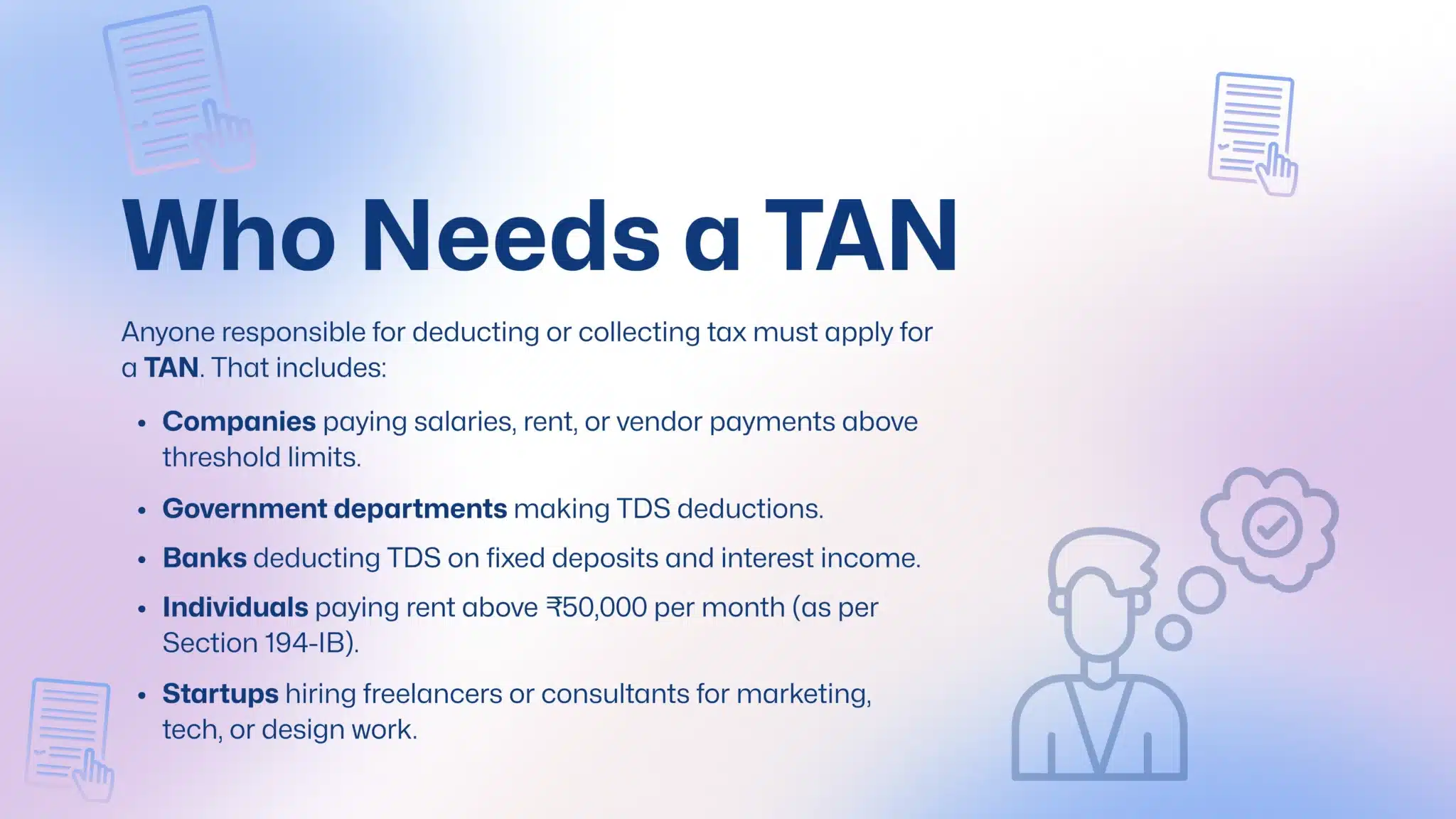
- Companies paying salaries, rent, or vendor payments above threshold limits.
- Government departments making TDS deductions.
- Banks deducting TDS on fixed deposits and interest income.
- Partnership firms paying contractors or consultants.
- Individuals paying rent above ₹50,000 per month (as per Section 194-IB).
- Startups hiring freelancers or consultants for marketing, tech, or design work.
Even if you’re a small business or a self-employed professional, you need a TAN number once you start deducting tax. The tan full form in income tax rules make this mandatory for every deductor, regardless of size or sector.
How to Apply for a TAN
Getting a TAN is simple — you can apply online or offline.
Online TAN Application
- Visit https://tin.tin.nsdl.com/tan/.
- Select “Apply Online for TAN.”
- Fill out Form 49B with your business or personal details.
- Pay a processing fee of ₹65.
- Submit the form and note your acknowledgment number.
- Once verified, your TAN number will be sent to your address and email.
The process takes about 5–7 working days, and you can track your application anytime online.
Offline TAN Application
- Download Form 49B from the Income Tax website.
- Fill it neatly in capital letters.
- Submit it at your nearest TIN Facilitation Center (managed by NSDL).
- Pay the application fee.
Within 10–15 days, your TAN will be processed and sent to you. Once received, quote it in all TDS-related communications.
Checking Your TAN Status
After applying, you can track your tan application online:
- Visit the NSDL-TIN portal.
- Enter your acknowledgment number.
- The system will show your TAN number status pending, under process, or issued.
Once it’s active, you can verify it anytime on the TRACES or NSDL website.
TAN vs PAN
This is where most confusion happens. People often think PAN and TAN are the same — they’re not.
| Point | PAN | TAN |
| Full Form | Permanent Account Number | Tax Deduction and Collection Account Number |
| Purpose | Identifies taxpayers | Identifies tax deductors and collectors |
| Issued Under | Section 139A | Section 203A |
| Who Needs It | All taxpayers | Only those who deduct/collect TDS or TCS |
| Used For | Income tax filing | TDS/TCS payments and returns |
Even if you already have a PAN, you must apply for a TAN number if you handle TDS or TCS.
Common Mistakes to Avoid
Here are a few frequent errors people make:
- Using PAN instead of TAN while filing TDS returns.
- Entering the wrong TAN on challans or returns.
- Deducting tax before applying for TAN.
- Not updating TAN details after changing business names or addresses.
Even a single mismatch can lead to delays, rejected returns, or penalties. Always double-check before submitting.
Correcting or Cancelling a TAN
If you realize your tan application has errors like wrong address or spelling it’s easy to fix.
- Go to the NSDL-TIN website.
- Choose “TAN Correction.”
- Fill out the correction form with correct details.
- Pay the correction fee.
If your business closes or no longer deducts tax, you can also request TAN cancellation by writing to your local Assessing Officer with proof.
Penalties for Ignoring TAN
Not applying for a TAN number when required, or quoting it incorrectly, can cost you.
Under Section 272BB, the Income Tax Department can levy a penalty of ₹10,000.
Also, if you file TDS returns without a valid TAN, they’ll be rejected automatically delaying refunds, affecting your reputation, and even leading to scrutiny notices.
In the financial year 2023–24, more than 1.2 lakh TDS filings were flagged for errors due to wrong or missing TAN details. That’s a lot of unnecessary stress for something that takes less than an hour to set up.
Final Thoughts
The TAN number might look like just another tax formality, but it’s the foundation of India’s TDS system. Without it, no tax deduction or collection can be officially recognized.
The tan full form, Tax Deduction and Collection Account Number, isn’t just a title it’s a tool for transparency and traceability. It ensures that every rupee deducted from someone’s income finds its way into the right government account.
Whether you’re a small business, a consultant, or a large organization, applying for a TAN is quick, affordable, and essential. Once you have it, quote it on every TDS certificate, challan, and return.
Getting your tan application right means staying compliant, avoiding fines, and building a clean tax record. It’s a small step that saves a lot of headaches later.
For personalized guidance on setting up your business in India, stay connected with FinGuru India and start your entrepreneurial journey today.
Need help with your TAN application or TDS compliance?
Book a Consultation with Our Expert
Call Us: +91-9999127022
Visit: www.FinGuruIndia.com
Our tax experts handle everything from registration to return filing so you can focus on growing your business while we handle the paperwork.