
India is seeing a strong rise in new businesses. Programs like Startup India and a growing focus on innovation have made it easier for people to turn ideas into real ventures. Professionals, startups, and even established companies are now looking for simple and flexible ways to start a business.
One popular option is LLP company registration in India.
An LLP, or Limited Liability Partnership, combines the ease of a partnership with the safety of a company. You can manage the business freely, like a partnership, while your personal assets stay protected if the business faces losses or debts. This balance is why LLP registration in India is a preferred choice for many new entrepreneurs.
That said, many people still ask the same questions: Who can start an LLP in India? What steps are involved in the registration process?
This guide answers those questions clearly. It explains the rules, legal requirements, partner roles, and the full process of LLP company registration in India, so you can move forward with confidence.
In this blog, we cover:
- Eligibility to Start an LLP Who can legally form an LLP in India, including individuals, NRIs, foreign nationals, and companies.
- Legal Requirements Key conditions such as the minimum number of partners, designated partners, documents needed, and legal compliance.
- Types of Partners The difference between Designated Partners and other partners, along with their roles and duties.
- Step-by-Step Registration Process From choosing a name to completing post-registration compliances, explained simply.
- Professional Tips Practical advice to avoid common mistakes and make the process smoother.
What is a Limited Liability Partnership (LLP)?
A Limited Liability Partnership (LLP) is a registered legal entity that offers its partners limited liability. It means that the personal assets of the partners are not at risk for the debts or liabilities of the LLP, except in cases of fraud or wrongful acts.
Introduced by the Limited Liability Partnership Act, 2008, LLPs are widely used in sectors such as professional services (including consulting, accounting firms, and law firms), IT startups, and other knowledge-based industries. Many early-stage founders choose LLP company registration in India because it strikes a balance between flexibility and protection.
Why LLP is a Preferred Business Structure in India
Here’s why many businesses, especially startups, freelancers, and professionals, prefer LLP:
- Limited Liability: Personal assets of partners are protected from business liabilities.
- No Minimum Capital Requirement: You don’t need heavy funds to start an LLP—start with as low as ₹1,000.
- Separate Legal Entity: The LLP can own assets, sue, and be sued separately from its partners.
- Flexible Profit Sharing: Profit distribution is not proportional to capital contribution—it’s customizable.
- Taxation Benefits: LLPs are taxed at a flat rate of 30%, but they don’t pay Dividend Distribution Tax (DDT), unlike companies.
- Ease of Compliance: Compared to private limited companies, LLPs have fewer compliance requirements and filings.
These benefits make LLP company registration in India attractive for lean teams and growing ventures alike.
Who Can Start an LLP in India?
Let’s break this down in detail:
1. Eligibility for Indian Citizens
- Any individual who is 18 years or older, of sound mind, and capable of entering into contracts can become a partner.
- There are no restrictions based on profession. Whether you’re an engineer, designer, consultant, or small trader, you can start an LLP registration in India.
- Partners can be actively involved in running the business or can be silent partners contributing only capital.
2. Eligibility for NRIs and Foreign Nationals
Yes, Non-Resident Indians (NRIs) and foreign nationals can form a Limited Liability Partnership (LLP) in India. However, the law ensures that the LLP has at least one Indian resident as a Designated Partner.
Conditions:
- At least one Designated Partner must have stayed in India for 120 days or more in the previous financial year.
- NRIs and foreign nationals must possess:
- A valid passport
- Address proof (not older than 2 months)
- Documents must be notarised or apostilled, depending on the country.
- A PAN is mandatory for NRIs to file taxes in India. Many NRIs choose LLP company registration in India because of the flexibility and low compliance burden.
3. Eligibility for Companies and Other Legal Entities
It’s not only individuals who can start an LLP. Even the body corporates can become partners, such as:
- Private Limited Companies
- Public Limited Companies
- LLPs (domestic or foreign)
- Foreign Companies, subject to FEMA and FDI guidelines
This allows larger groups and foreign companies to enter India via LLP registration in India for consulting, tech, or professional activities.
Minimum Requirements for Starting an LLP in India
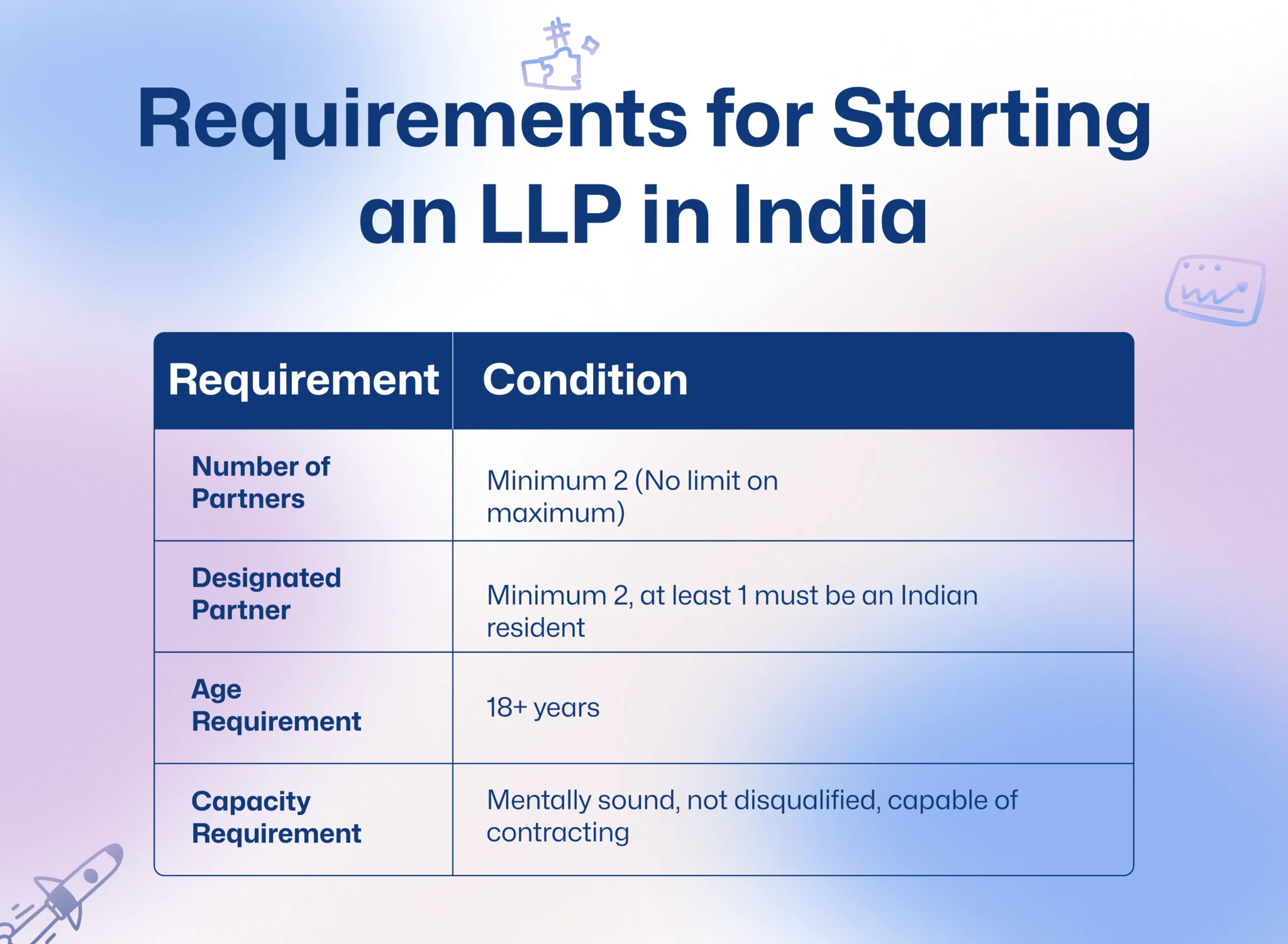
These minimums apply to all LLP company registration in India filings.
Disqualifications and Restrictions
Certain individuals cannot become partners in an LLP:
- Who Cannot Form an LLP:
- Undischarged Insolvents: Individuals who haven’t cleared their insolvency proceedings.
- Persons of Unsound Mind: Declared mentally unsound by a competent court.
- Convicted Individuals: Anyone convicted of offences involving moral turpitude and sentenced to imprisonment of at least 6 months within the last 5 years.
- Companies Barred by Law: Companies that are not allowed to start an LLP include those that have been disqualified under Section 164 of the Companies Act, 2013, meaning they have failed to meet key compliance requirements like annual filings or repaying debts. Additionally, companies facing restrictions by regulatory authorities like SEBI or RBI for financial misconduct are also barred.
These restrictions help maintain integrity during LLP registration in India.
Types of Partners in an LLP
- Individual Partners:
Indian citizens, Non-Resident Indians (NRIs), and foreign nationals can act as partners, contributing capital, skills, or knowledge to the Limited Liability Partnership (LLP). - Body Corporate Partners:
Other LLPs, companies, or foreign LLPs/entities can be admitted as partners to expand resources, networks, or skills.
Two Types of Roles in LLP:
| Type | Responsibility |
| Designated Partner | Filing compliance documents, legal responsibility, penalty liability, and signing contracts. |
| Ordinary Partner | Shares profits, no mandatory filing responsibility unless agreed in the LLP Agreement. |
These distinctions matter during LLP company registration in India, especially while drafting the LLP Agreement.
Can Foreign Nationals or Entities Start an LLP?
Yes, but subject to FDI (Foreign Direct Investment) norms.
FDI Rules for LLPs:
- Foreign Direct Investment (FDI) up to 100% is allowed in LLPs through the automatic route, meaning that no prior government approval is required, provided the business is in a sector where 100% FDI is already permitted for companies. This policy opened doors for international firms seeking LLP registration in India.
- No prior government approval is needed for these sectors.
- No FDI is permitted in:
- Banking and Insurance
- Agriculture
- Real estate business
- Sectors requiring prior approval for foreign investment.
Conditions for Foreign LLPs/Entities:
- Must comply with FEMA, FDI policy, and sectoral guidelines.
- Foreign entities must provide proof of incorporation, and their representatives need identity verification.
Documents Required for LLP Registration
| For Indian Nationals | For NRIs/Foreign Nationals |
| PAN Card | Valid Passport (Mandatory) |
| Aadhaar Card | Address Proof (Utility Bill, Driving License, Bank Statement) |
| Address Proof (Voter ID/Driving License) | Apostille/Notarization as per country rules |
| Passport Size Photographs | Photograph |
These form the backbone of every LLP company registration submission in India.
For LLP Office Address Proof:
- Rent Agreement (if rented)
- Utility Bill of Premises (Latest)
- No Objection Certificate (NOC) from property owner
Legal and Regulatory Requirements for LLPs
1. Digital Signature Certificate (DSC): Required for online filing of documents.
2. Director Identification Number (DIN): Required for all Designated Partners.
3. LLP Name Approval: Apply through the RUN-LLP service on the MCA website.
4. LLP Agreement: A crucial document detailing the roles, rights, and duties of partners—must be filed within 30 days of incorporation.
5. Post-Incorporation Registrations:
- PAN
- TAN (Tax Deduction Account Number)
- GST (if applicable)
- Professional Tax (in applicable states)
These steps are part of the standard LLP registration in India workflow.
Step-by-Step Overview of the LLP Registration Process
| Step | Description |
| Name Reservation | Via RUN-LLP on the MCA Portal |
| Incorporation Form | File FiLLiP (Form for Incorporation of LLP) with documents |
| Obtain DIN | Along with FiLLiP or separately (if required) |
| Filing of LLP Agreement | Within 30 days of incorporation date |
| PAN & TAN | Mandatory for banking and tax purposes |
| Open a Bank Account | For business transactions |
Every startup going through LLP company registration in India follows this process.
Conclusion:
Should You Start an LLP?
An LLP is ideal for:
- Startups aiming for operational flexibility with limited compliance.
- Professional service firms need personal asset protection.
- Businesses are entering partnerships with foreign entities.
Summary of Eligibility:
- Minimum two partners (1 Indian resident mandatory)
- Individuals (Indian/NRIs/Foreigners) & Body Corporates allowed
- Subject to compliance with LLP Act, FEMA, and FDI policies
- Proper documentation and registrations required for legality and taxation
If you’re considering LLP registration in India or planning LLP company registration in India, the structure is a strong choice for long-term stability and flexibility.
Need Help Starting Your LLP? FinGuru India Can Help.
At FinGuru India, we’ve helped hundreds of entrepreneurs, startups, and businesses register and manage their LLPs with complete end-to-end support. Whether you’re setting up your first business or expanding internationally, our team of experts handles incorporation, compliance, taxation, and advisory under one roof.
Visit us at Finguru India or connect with us to schedule a free consultation.
Don’t just start your LLP—start it the right way, with FinGuru India by your side.