
Before you strike off an inactive private limited company, you need to know the Company Strike Off fees in India. Closing a clean company with no pending ROC filings could cost between ₹20,000 to ₹35,000 in 2026. However, if the company has pending AOC-4, MGT-7, GST returns or DIR-3 KYC defaults, the total cost can go up to ₹70,000 to ₹1.5 lakh or more.
That’s where a lot of founders get confused. They hear Form STK-2 costs Rs. 10,000 and assume that is the entire closure cost. No. The actual bill is subject to pending ROC filings, late fees, GST closure, professional charges and whether the company’s books are clean enough for strike off.
Company Strike Off Cost in India 2026 at a Glance
For a clean company, strike off usually stays in the ₹20,000 to ₹35,000 range. Once the company has old filings, GST issues, or director KYC defaults, the cost can jump quickly.
| Cost Component | Typical Cost |
| STK-2 government filing fee | ₹10,000 |
| CA/CS professional fee | ₹8,000 to ₹30,000 |
| Statement of accounts certification | ₹3,000 to ₹8,000 or included |
| Affidavit, indemnity bond, stamp paper, and notarisation | ₹2,000 to ₹8,000 |
| Pending AOC-4 / MGT-7 and ADT-1 filing cost | Variable |
| ROC additional fee for delayed annual filing | ₹100 per day in many cases |
| DIR-3 KYC late fee | ₹5,000 per director |
| GST cancellation support | ₹3,000 to ₹10,000 |
What Is the Company Strike Off?
Company strike off means removal of the name of a company from the Register of Companies under Section 248 of the Companies Act, 2013. This is the legal method of closing down a company which has ceased trading and has no further use.
For voluntary closure, companies generally file Form STK-2 under section 248(2) read with Rule 4 of the Companies (Removal of Names of Companies from the Register of Companies) Rules, 2016.
Who Can Apply for Company Strike Off?
If a company has ceased trading and the promoters wish to wind it up properly, rather than leaving an idle entity hanging around, they can apply for strike off.
In practice, strike off is best suited to companies that have no future business plan, no major liabilities and no serious legal or tax disputes. Ideally, before filing STK-2, the company should:
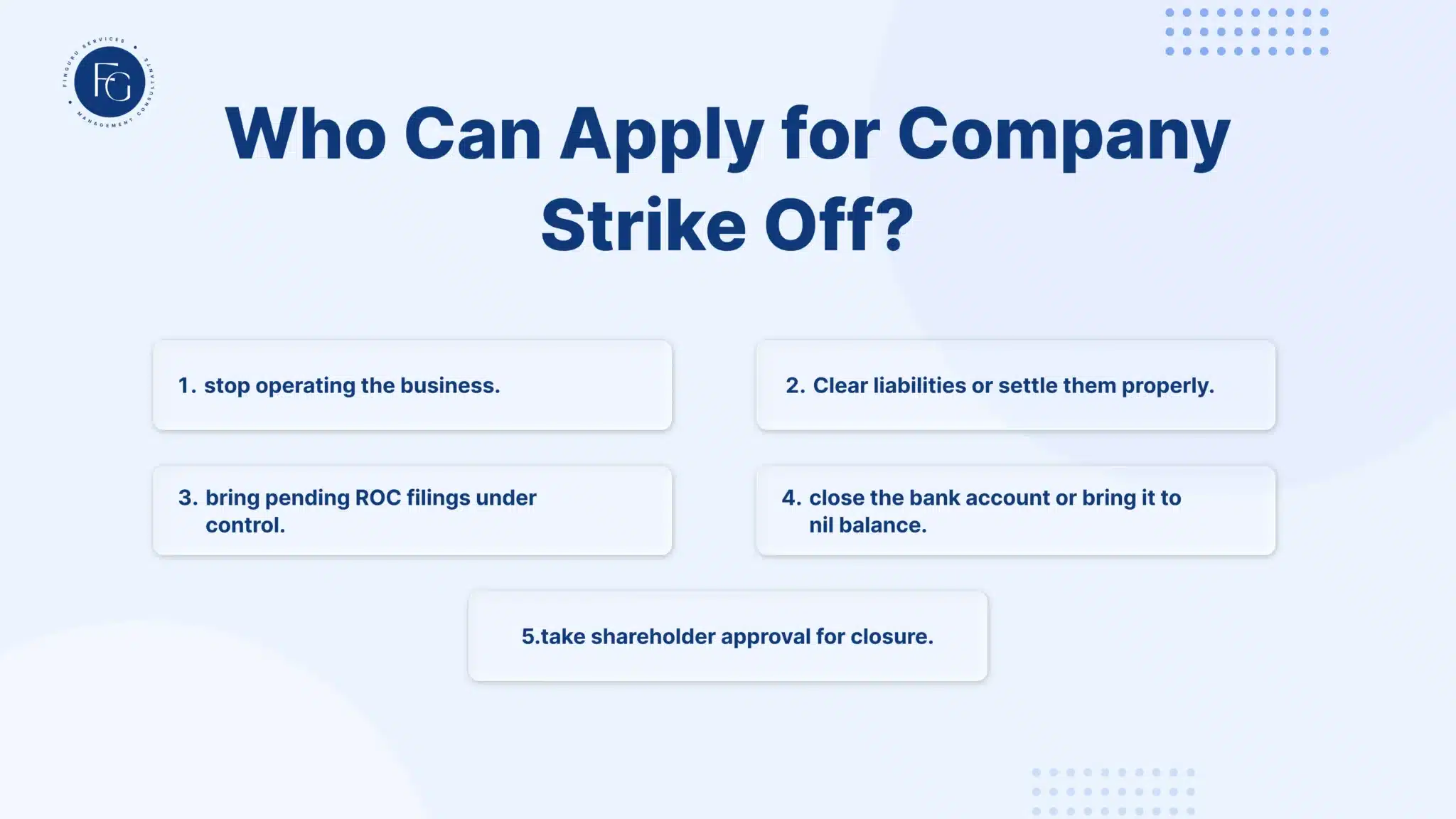
If the company still has outstanding creditors, active loans, tax disputes or significant compliance defaults, strike off becomes more difficult and costly.
Government Fee for Company Strike Off in India
The government filing fee for Form STK-2 is ₹10,000. This is the fixed MCA fee payable when filing the strike off application.
But this is only the base filing fee. A proper strike off also needs an indemnity bond, affidavits, a statement of accounts certified by a practising professional, board and shareholder resolutions, and often some GST or ROC cleanup before filing.
So yes, the STK-2 fee is fixed. But the total cost depends on how much work is needed before the company becomes ready for closure.
CA / CS Professional Fees for Strike Off
Professional fees vary because every company has a different compliance history. A clean company is simple to close. A company with pending annual filings, inactive DINs, missing books, or GST issues takes much more work.
As a broad range, professional fees may fall around:
- ₹8,000 to ₹20,000 for a clean company
- ₹20,000 to ₹40,000 where some pending work needs to be fixed
- ₹40,000+ where the company has heavy non-compliance or messy records
These fees usually cover eligibility review, drafting STK-2 documents, statement of accounts support, MCA filing, and replies to ROC resubmissions.
Why One CA Quotes ₹15,000 and Another Quotes ₹60,000
This is where founders make the wrong comparison.
A lower quote usually covers only basic STK-2 filing support for a clean company. A higher quote often includes the messy work that actually drives up the bill, such as filing old AOC-4 and MGT-7 returns, calculating late fees, reactivating DIN through DIR-3 KYC, preparing missing financial statements, or cleaning up GST and bank mismatches.
So do not compare only the number. Compare the scope of work.
Hidden Costs That Increase Company Strike Off Cost
The biggest mistake founders make is budgeting only for STK-2. In real cases, the hidden costs are what push the final bill up.
Pending ROC annual filing fees: If AOC-4 or MGT-7 is pending, the company may need to file those overdue forms before or alongside closure planning. Delayed filings under Section 92 and Section 137 can sharply increase the cost because additional fees keep piling up.
DIR-3 KYC default: In case the DIN of a director gets deactivated due to non-filing of DIR-3 KYC, the strike off process may get delayed. Late filing practically is a penalty of Rs. 5,000/- per director.
GST cancellation and old liabilities: If GST is active, the company may have to clear out pending returns, file for cancellation and complete final compliance work. Also if the books still show unsecured loans, receivables, payables or bank mismatches these usually need to be tidied up before strike off.
Conclusion
The Company Strike Off Cost in India is not just the ₹10,000 STK-2 filing fee. The final cost depends on the company’s compliance position at the time of closure. If annual filings are up to date, director KYC is complete, GST is closed, and the books are clean, strike off stays fairly affordable.
But if the company has pending ROC filings, tax issues, old liabilities, or director defaults, the cost can rise quickly because every unresolved issue adds more work, more professional fees, and sometimes extra penalties.
Unsure how much your company closure will actually cost? Get a compliance review from FinGuru India. Our team can identify pending ROC filings, DIR-3 KYC defaults, GST issues, and estimated strike-off expenses before you start the closure process.


