
After you complete private company registration in India, it is very important to put together a strong leadership team for smooth operations and long-term growth. Directors play a key role in running the company, seeing to it that we are compliant and also in which we make strategic decisions.
As your company grows, you may have to add new directors, which in turn will bring in specialized skills, share out responsibilities, or fulfill legal and operational requirements. But appointing a director is not a pure business decision. It is also subject to the legal structure as outlined in the Companies Act of 2013.
This guide will explain what directors do, why you should hire them, what the law requires, and how to add a new director to your company step by step.
Role of a Director After Private Limited Company Registration in India
Directors are the core of a company’s management and governance. Upon registration, your company directors take over its day-to-day operations.
Key responsibilities include:
- Strategic Management: Planning for business scale-up and beyond the horizon.
- Operational Control: Running day-to-day business operations and decision-making.
- Legal Compliance: Ensure that the company is in full compliance with all statutes.
- Fiduciary Duties: Acting in the best interest of the business and its stakeholders.
One of the most important jobs in a private limited company is that of a director, who is both a manager and a lawyer.
Why Should You Hire Directors After Registering a Private Limited Company in India?
Upon completion of your private limited company registration in India, appointing more directors may see your company grow in many ways:
- Specialized Expertise: Brings in professionals who have finance, marketing, and legal backgrounds.
- Business Expansion: Supports market expansion and the introduction of new products.
- Investor Requirements: Investors may have a seat on the board.
- Improved Governance: Improves transparency and compliance.
Adding directors is a good move for your company to be better prepared for growth and challenges.
Legal Requirements to Appoint a Director
The appointment of directors is governed by the Companies Act, 2013. Companies must follow these legal provisions:
Minimum Directors:
2 for a private limited company
Maximum Directors:
Up through 15 (with more possible by special resolution).
Key Sections to Follow:
Section 152: Appointment of directors
Article 161: Other and substitute directors.
Section 164: Disqualification criteria
Additional Requirements:
Director Identification Number (DIN)
Digital Signature Certificate (DSC)
Consent to act as director
Failure to abide by these rules will nullify the appointment and bring penalties.
Types of Directors in a Private Limited Company in India
Identifying what type of director is right for you is key to structuring your business:
- First Directors: At the time of company founding.
- Additional Directors: Selected by the Board for extra support.
- Alternate Directors: Present in place of an absent director.
- Nominee Directors: Represent financial stakeholders.
- Independent Directors: Optional for private companies.
- Managing Director (MD) / Whole-Time Director (WTD): Handle daily operations
Each type serves a different purpose depending on the company’s needs.
Who Can Become a Director in a Private Limited Company in India?
The Companies Act specifies strict eligibility criteria for those seeking to serve as directors, as not every individual is qualified for the position.
Basic requirements:
- Must be a person.
- Must be over 18 years of age.
- Must have a valid DIN
- Must be mentally competent
Both resident Indians and foreign nationals (including NRIs) may serve as directors if they meet the compliance requirements.
Eligibility Criteria for Company Directors Before Appointment
Before putting forward a director for appointment, see to it that they meet the criteria.
- Not declared insolvent.
- No prior criminal records for financial offenses.
- Not disqualified under the Companies Act.
- Do not be one of those who failed compliance for 3 years in a row.
- In the past 12 months, a director had to have spent at least 182 days in India.
Documents Required to Appoint a New Director in a Private Limited Company
To ensure a seamless appointment process, present the following documents:
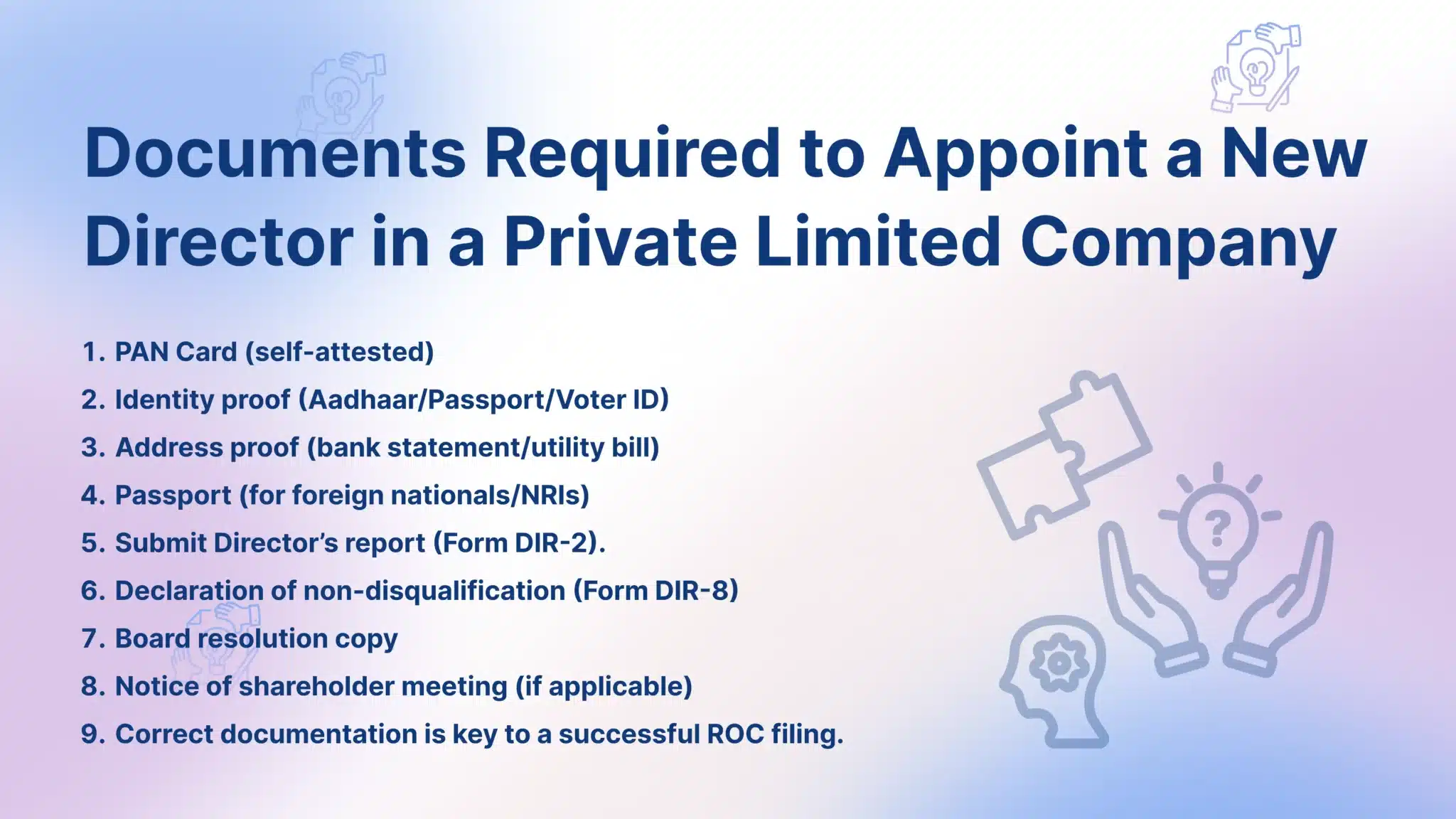
How to Appoint a New Director in a Private Company?
Follow this step-by-step process to appoint a new director after a private limited company registration in India:
Step 1: Review Articles of Association (AoA)
Make sure the AoA includes the appointment. If needed, amend it.
Step 2: Get DIN
Apply if you do not have your DIN yet, which you may do via Form DIR-3.
Step 3: Get that which stands for DSC
Proposed directors must have digital signature certificates.
Step 4: Obtain Permission
Gather up Form DIR-2 and DIR-8, which the director has.
Step 5: Run Board Meeting
Conduct a board meeting to pass the resolution and decide if shareholder approval is needed.
Step 6: File Directory DIR-12
Submit DIR-12 to MCA within 30 days of your appointment.
Step 7: Modify Company Information
Update company records such as the register of directors, bank details, website, and letterheads.
Step 8: Issue Appointment Notice
Present a detailed letter that covers duties, role, and terms.
Common Mistakes When Adding Directors After Private Limited Company Registration
Avoid these common errors to ensure compliance:
- Ignoring AoA provisions before appointment.
- Delayed filing of DIR-12, which in turn incurs penalties.
- Incorrect forms (DIR-2/DIR-8) are causing rejection.
- Not updating statutory registers.
- Unclear roles and responsibilities
Proper preparation and compliance will avoid legal issues and ensure a smooth onboarding process.
Conclusion
Company registration in India is only the starting point. Long-term success depends on staying compliant with ROC filings.
Delays and missed filings can result in fines, legal problems, and even the end of a company. On the other hand, following the rules on time builds trust, boosts credibility, and helps businesses grow.
Most businesses fail here because they think compliance is a one-time thing. No, it isn’t. It needs to be consistent and correct. That’s where FinGuru India comes in. Businesses can file ROC papers correctly and on time with the help of experts, and they can stay fully compliant.
Do not wait for penalties to act. Get expert help from FinGuru India today.


