
If your Indian company has issued shares or other eligible equity instruments to a foreign investor, the next step is reporting the allotment to the Reserve Bank of India through Form FC-GPR.
The filing is completed on RBI’s FIRMS portal and reviewed by the company’s Authorised Dealer bank. Missing the deadline, uploading incomplete documents or entering details that do not match company records can lead to delays, bank queries and late filing fees.
This FC-GPR filing guide explains who must file, how to complete the process, which documents are required, the filing deadline and the common mistakes to avoid.
This article provides general procedural guidance. It does not replace advice or filing support from an Authorised Dealer bank or qualified compliance professional.
Important: File Form FC-GPR within 30 days of the allotment of eligible capital instruments. Delayed filings may require payment of the applicable Late Submission Fee (LSF).
What Is FC-GPR and When Is It Required?
FC-GPR stands for Foreign Currency Gross Provisional Return. An Indian company uses this form to report the issue of shares or other eligible equity instruments to a person resident outside India.
In simple terms, when an Indian company receives foreign investment and allots new equity instruments to a foreign investor, it must report that allotment to RBI. The filing is made through the Single Master Form available on RBI’s FIRMS portal.
FC-GPR may be required for:
- Equity shares
- Compulsorily convertible preference shares
- Compulsorily convertible debentures
- Rights shares issued to foreign investors
- Bonus shares issued to foreign investors
- Eligible employee stock options
- Sweat equity shares
- Shares issued after the conversion of eligible instruments
- Certain merger-related or non-cash allotments
Since documentation and reporting requirements may differ depending on the transaction, companies should verify the applicable FEMA provisions before filing.
Note: The requirement to file FC-GPR arises after the company allots the capital instruments, not when it merely receives the foreign remittance.
FC-GPR vs FC-TRS: What’s the Difference?
Many companies confuse FC-GPR with FC-TRS, but these forms report two different types of foreign investment transactions.
| FC-GPR | FC-TRS |
| Reports the fresh issue or allotment of capital instruments to a non-resident | Reports the transfer of existing capital instruments between a resident and a non-resident |
| Filed by the Indian company issuing the shares | Filed for a qualifying share transfer through the AD Bank |
| Applicable when new shares are created and allotted | Applicable when ownership of existing shares changes |
In simple terms, FC-GPR is used for a fresh issue of shares, whereas FC-TRS is used for the transfer of existing shares. Understanding this distinction helps companies choose the correct RBI reporting form and avoid unnecessary filing errors.
Who Is Responsible for Filing FC-GPR?
The Indian company receiving foreign investment is responsible for filing Form FC-GPR. An authorised representative submits the return through the company’s Business User account on the RBI’s FIRMS Portal, and the selected Authorised Dealer (AD) Category-I Bank reviews the filing before processing it.
The AD Bank may approve the return, seek clarification, return it for correction, or reject it if important information is missing.
Filing FC-GPR does not replace other legal obligations. Companies must also comply with the Companies Act, FEMA regulations, tax laws, and other applicable requirements.
So, if you are planning to establish an Indian entity? Explore our Foreign Subsidiary Registration in India service.
How to File FC-GPR Through RBI’s FIRMS Portal
If you’re wondering how to file FC-GPR, start by verifying your company details and gathering the required documents. The filing is completed through the Single Master Form on the RBI’s FIRMS Portal and submitted to your Authorised Dealer (AD) Category-I Bank for verification.
Step 1: Verify Your Entity Master and Business User Details
Before starting the filing, ensure your company’s Entity Master information is accurate and your Business User account is active.
Verify the following details:
- Company name
- Corporate Identification Number (CIN)
- PAN
- Registered office address
- Business activity and sector
- Paid-up share capital
- Existing foreign investment
- Current shareholding pattern
- Registered email address and contact details
- Selected Authorised Dealer (AD) Bank and branch
Incorrect Entity Master information or an inactive Business User account can delay the filing process.
Step 2: Access the Single Master Form and Select FC-GPR
Log in to the RBI’s FIRMS Portal and navigate to:
FIRMS Portal → Single Master Form → Return Type → FC-GPR → Add New Return
The RBI may update the portal interface from time to time, so verify the latest screen layout before beginning the filing.
Step 3: Enter the Allotment and Investor Details
Provide the allotment date, type and number of eligible capital instruments, issue price, and complete details of the foreign investor. If the remitter and allottee are different, include the required supporting information.
Step 4: Enter the Remittance and Shareholding Details
Next, record the foreign remittance details, FIRC information, valuation details, and the company’s shareholding before and after the allotment. Ensure these figures match your statutory records.
Step 5: Upload the Required Documents
Upload all supporting documents under the appropriate categories in the FIRMS Portal. Before proceeding, verify that every document is complete, signed where required, and clearly legible.
Typical documents include:
- FIRC or bank remittance proof
- KYC report
- Valuation certificate
- Board Resolution
- Shareholding pattern
- PAS-3 acknowledgement, where applicable
- Other supporting documents required for the transaction
Step 6: Review and Submit the FC-GPR Form
Before submitting the return, carefully review every detail to ensure consistency across the form and supporting documents. Pay special attention to the investor’s information, allotment date, valuation, remittance amount, and shareholding details.
Once verified, submit the form to your selected Authorised Dealer (AD) Category-I Bank. Save the acknowledgement number and monitor the FIRMS Portal and your registered email address for any queries or requests for clarification from the AD Bank.
Expert Insight: Most FC-GPR delays result from inconsistencies between the valuation certificate, Board Resolution, PAS-3, and shareholding records. A final review before submission can help avoid unnecessary corrections.
Documents and Information Required for FC-GPR Filing
This FC-GPR filing guide helps reduce bank questions. Companies should keep these records ready:
- Bank proof showing receipt of foreign funds, commonly called an FIRC
- KYC report for the investor or sender
- Valuation certificate supporting the issue price
- Certified board resolution approving the allotment
- List of allottees
- Shareholding details before and after allotment
- Declaration and authority letter for the filer
- Investment agreement, where relevant
- Government approval, where required
- PAS-3 acknowledgement or allotment records, if requested
- Extra KYC, consent, and explanation papers when the sender and allottee differ
Also keep the payment and allotment dates, amounts, instrument details, issue price, and foreign holding percentage ready.
The document list for the FC-GPR form India may vary by transaction and bank. Confirm it with the AD bank. This is a key step in an FC-GPR filing guide.
FC-GPR Due Date and Late Filing Consequences
The FC-GPR due date is 30 days from the date of allotment of eligible capital instruments to a person resident outside India. The timeline starts from the allotment date, not the date the foreign investment is received.
For example, if shares are allotted on 10 September, the company should ordinarily file Form FC-GPR by 10 October.
If the filing is delayed, the company may be required to pay the applicable Late Submission Fee (LSF) before the return can be processed.
The LSF is calculated using the RBI’s prescribed formula:
LSF = ₹7,500 + (0.025% × A × n)
Where:
- A is the amount involved in the delayed reporting.
- n is the period of delay calculated under RBI guidelines.
Paying the LSF only regularises the reporting delay. The company must still complete the filing and respond to any queries raised by its Authorised Dealer Bank.
Common Errors That Trigger AD Bank Queries or Rejection
Many FC-GPR filings are delayed because the information in the form does not match the supporting documents. A careful review before submission can help avoid unnecessary corrections.
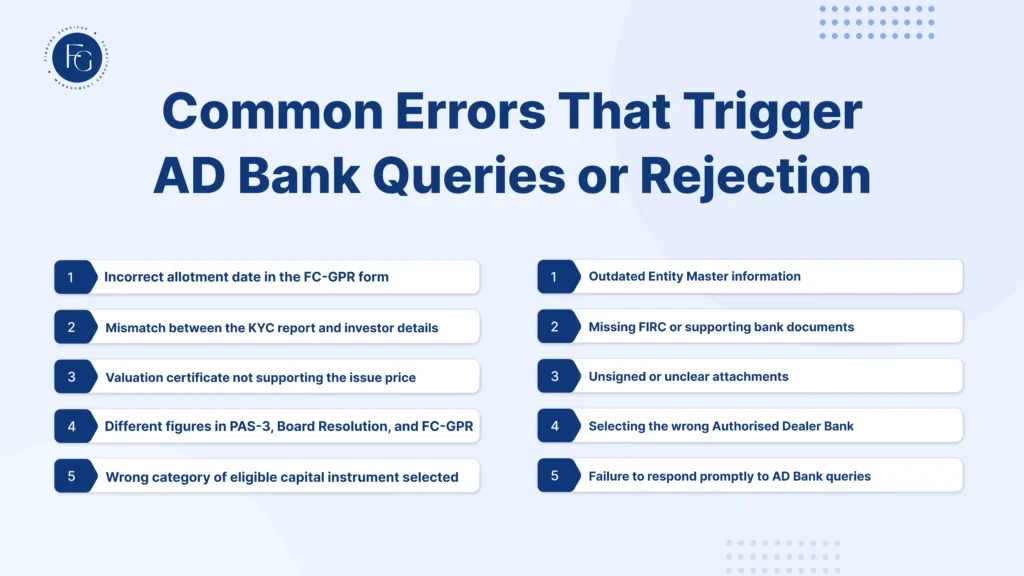
Before submitting the return, compare your FIRC, KYC report, valuation certificate, Board Resolution, PAS-3, and shareholding records to ensure that all information is consistent.
Disclaimer: This guide provides general procedural information about FC-GPR filing. It does not replace filing through an Authorised Dealer (AD) Category-I Bank or professional advice on FEMA compliance and foreign investment reporting.
How FinGuru Helps with FC-GPR Filing
Filing Form FC-GPR involves more than completing an online form. Companies must verify FEMA compliance, prepare supporting documents, coordinate with their Authorised Dealer (AD) Bank, and respond promptly to any queries. Even small errors in valuation, investor details, or shareholding information can delay the approval process.
At FinGuru India, we provide end-to-end assistance for FC-GPR filing and foreign investment compliance. Our team works closely with startups, private limited companies, and foreign-owned businesses to ensure timely and accurate RBI reporting.
Our FC-GPR filing services include:
- Reviewing the transaction for FEMA compliance
- Preparing and verifying all required documents
- Assisting with Business User registration on the FIRMS Portal
- Preparing and submitting Form FC-GPR
- Coordinating with your Authorised Dealer (AD) Bank
- Responding to RBI or AD Bank queries
- Assisting with delayed filings and Late Submission Fee (LSF) regularisation
- Advising on ongoing FEMA and foreign investment compliance
Whether you have received your first foreign investment or need help correcting a previously submitted return, our compliance experts can guide you through every step of the FC-GPR filing process and help you avoid unnecessary delays.
Not sure how to complete your FC-GPR filing? Our FEMA experts can help you prepare the required documents, coordinate with your Authorised Dealer Bank, and complete the filing accurately and on time. Book a Consultation.


